Holding on We clutch our ideas, notions and feelings like my 1 year old daughter grasping her toys and walking around the house. It’s cute sometimes but you have to eventually cleanup the mess. The difference lately is I’m aware of just how much I carry around in my head. Lately though I’ve been able to bring an awareness toward addressing this. The feeling is one of lightening. I put down these notions – baggage – and breathe in what is, right here and right now. I’m confident that should I need one of these ideas I can pick it up and then interact with it from there. No need to carry it because I know it’s there if I need it. An odd and liberating feeling.
Stressful roots Tracing stress back to grade school it really began when I went to middle school. I was in a Jewish day school until 7th grade. From there the transition to elite (no, elitist) prep school was jarring as I was thrown into a highly competitive situation that I didn’t fit into at all. The kids were overall cliquish and mean spirited, faculty blind to bullying, sports were the dominant mode of popularity, and the pecking order, while technically invisible as it’s a social construct, was evident in the clusters of bodies aggregated in various areas of the lounge area. It really was lord of the flies. Same as most middle schools.
There was really no emotional support system since my family was being literally ripped apart at the same time. As the oldest kid I tried to hold things together (unsuccessfully). All that is to say that stress has been a fixture in my life for a long time. So I’ve tried to make friends with it. My way of coping was to go towards instead of away. In retrospect there was much good in this decision. But it was a really hard road.
Mindfulness during stress It really feels trite to be writing this. Everyone talks about mindfulness these days. It’s taken on the same dismissal tone (to me) as talking about calories, budgets or well-meaning family telling you to put on a jacket if you go outside. But this one I’ve been taking seriously because it’s so close to my current day-to-day existence.
The other night I went to a Sunday night meditation with my brother Eli. If I feel up to it (and not in my super low immunity phase) I’ve been trying to go. It’s held at a Unitarian church near the tenderloin in SF. It’s not the nicest area but I do find it to be a comfortable spot despite the hideous concrete architecture (sometimes called “brutalist” for obvious reasons, which is both hilarious and kind of spot- on). Last Sunday it was led by a German monk and we did something different than the usual 45 minute sit. Instead we paired up and did some exercises meant to bring us into the moment. These are simple (but not easy) exercises: active listening, and 3-5 minute intervals of ‘mindful’ speaking – punctuated by long pauses/silence as we think about what we want to say instead of doing it habitually. We are so attuned to filling the silence with words that this is hard. It’s interesting to practice ‘applied’ meditation in that it more easily transfers to daily living. I don’t know of a more helpful kind of practice than being fully present. It’s kind of like doing wind sprints uphill – the flats are so much easier in comparison.
For example one exercise had us pair off and sit facing one another, just making eye contact for several minutes. Just! If you can think of a more uncomfortable mental practice I’d love to know. All kinds of stuff tends to come up when you’re staring into a stranger’s eyes from a distance of 2-3 feet, for minutes without looking away. Try and do that while at the same time remain centered, present and mindful. Talk about a spinning mind: it’s like a ping pong ball of what I’m thinking about you, to what you might be thinking about me, back and forth and back and forth.
Being at ease when doing this is an awesome mindfulness exercise because it’s real – it’s not artificially sitting with eyes closed pretending to be centered; you’re forced to be active and present. Generally speaking I’m drawn to applied practices that have connection to the real-world. After all, what we call ‘reality’ has stood the test of time so it’s the appropriate starting point.
Anyway I paired up with Eugene, the founder and leader of the Sunday group (an inspiringly humble, insightful and wickedly funny mindfulness teacher). At one point we were asked to take turns speaking for 5 minutes on the topic of generosity (speaker 1 is the one with more hair, so that was easy).
Specifically we were asked to talk about how we’ve recently shown generosity in our lives. I wasn’t sure how much to go into detail on my situation – didn’t want to feel like I was dumping. But I quickly decided if ever there was an appropriate context this is probably it. So, while holding direct eye contact and pausing to consider each phrase: I felt like it was important to first set some context. I’m in the middle of chemotherapy… I was diagnosed a few months ago with cancer… I have 3 kids under 6 that I try to spend more time with… I’m taking a break from everything to focus on healing and removing any extraneous stressors from my life so I can be with them as I go through this… I’m optimistic for a positive outcome but I don’t know how much time I have, none of us do really but it’s more visceral when going through something like this. Then, turning to the actual topic I continued. As much as I want to believe that I am a giving person, lately I’ve been on the receiving side of that equation and it’s totally out of balance. Any generosity I’ve shown lately is completely overwhelmed by that of my community/social circle…It’s completely disproportional to anything I might do…I have food on my doorstep most nights/daily calls/emails/blog comments/texts/ visits – I’m overwhelmed with kindness…being the recipient of so much generosity from others is hard for me and I have no idea how I could ever be able to pay it back…I’m coming to understand the idea sometimes called grace, which is just letting it be and appreciating things as they are…that said I feel both a shift in my values toward contribution as the highest good…figuring out how I might pay it back to those in my community, family, social circle, colleagues, humanity is a constant topic of thought…then again that in the end all of it – everything – is upside…we are here because of the gift of life…we are owed nothing… all of life is generosity… BELL!
I notice a shift in my values toward contribution as the highest good I now believe that that defining what meaningful contribution looks like is one of the most important questions in my life. He was gracious in telling me I was doing the right thing and expressed admiration for my approach, which was really touching coming from him. And he offered to help in any way he could – again this never loses it’s power – simple gestures of helping. I get the same feeling as I did in sports at the end of a game when the teams shake hands. I always felt that shaking hands embodied all that was good about humanity – I know it sounds crazy but I looked forward to that all during high school sports. I actually cried a few times thinking about it. Which is crazy because I spent a lot of time in the penalty box playing lacrosse, was awarded most versatile player on a high school championship team for playing most ‘downs’ in football (offense, defense, special teams etc.). But the juxtaposition of moving from enemy and combatant to someone you could shake hands with, in the space of a moment, at the blow of a whistle was astonishing. Popping up a level still is our ability as a species to devise games – levels of experiential abstraction – to which we abide. But then those rules can shift as we exit one space in favor of another. So that transition always fascinated me. Our psyches are so malleable as to exist in different contexts in the space of a moment. In this lens it seems not so hard to comprehend the quick shift in extreme social situations, even from say a peaceful Germany (center of learning) to Nazi Germany (center of planned death). Games are perhaps Links between cancer and stress https://www.ncbi.nlm.nih.gov/pmc/articles/PMC3341916/ stress can decrease the activity of cytotoxic T lymphocytes and natural killer cells and lead to growth of malignant cells, genetic instability, and tumor expansion (Reiche et al., 2004[88]) My view is that stress and anxiety are to be avoided while healing from something of this magnitude.
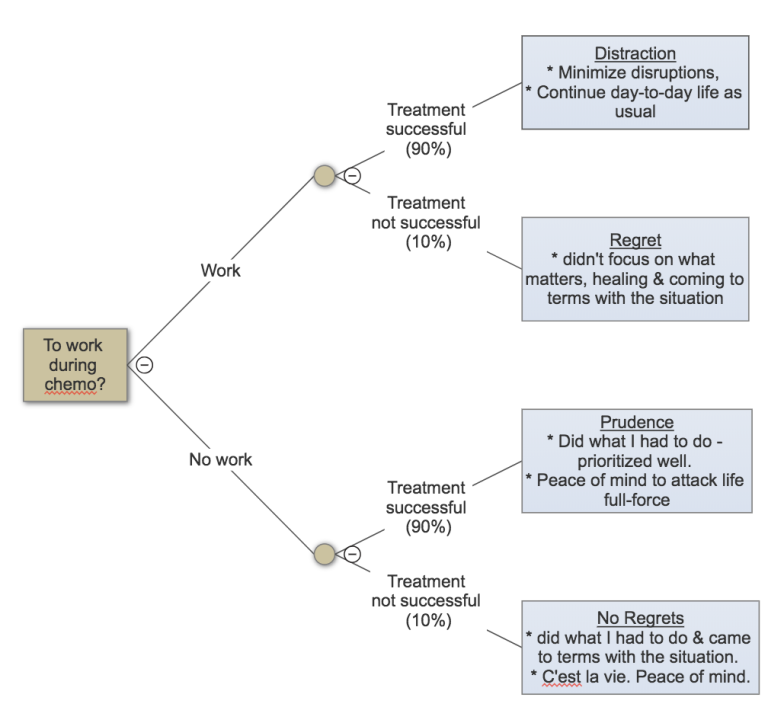
Especially since I’m neutropenic I need to avoid opportunistic infections. Those kinds of infections rely on compromised immunity. Immune function is related to stress. One question I resolved early on in this whole ordeal has been whether I ought to work during this chemotherapy. There have certainly been days when I felt up to it. But predicting this has been elusive – several times I’ve felt like I was in the clear several times only to get knocked back. I often find it helpful to structure the pieces in some type of framework to wrap my head around it. For example when I was deciding if I should work I used a decision tree – optimizing on regret minimization (typically you’d add expected probabilities and payoffs to optimize some output, say revenue). It’s really just an emotionally- based decision tree. While simple I think it captures the essence of the first order decisions required.
Note that the treatment success numbers are crude estimates (and in-fact they don’t really change the outcome, I could just as easily have used 1% as 10%). Also even if the treatment isn’t successful there’s alternative therapies – that admittedly I don’t understand yet, and I’m not going to try unless I have to. Anyway it’s clear that one branch leads to peace of mind whereas the other has potential for regret, hence my decision to not work. Again this was all emotional and didn’t even take into account my actual ability . Living with regret is bad.
Essentially the way I see it is I want an airtight psychology so ensure I’m treating body as cleanly as possible. I don’t want worry, stress, anxiety to interact with the physical healing process.