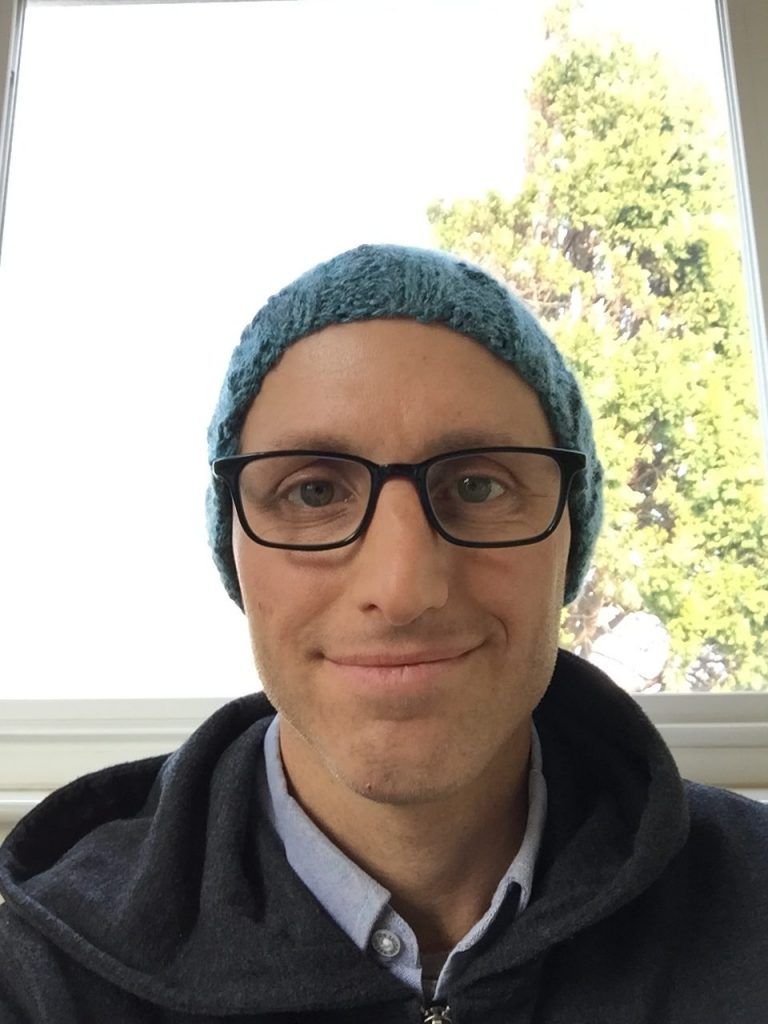
I was working and living in San Francisco. I had 3 kids under 6 years old at the time: Saul (6), Lev (4), Lua (20 months). Things were good: my wife Michelle and I were building our home and family, getting into rhythms of new schools, and quickly adjusting as new kid milestones emerged. All this was against the backdrop of working long hours as an e-commerce Product Manager downtown. I'd bike to work first thing, lock up and walk upstairs to my hip tech office overlooking the shimmering SF bay. I'd get to work with some of the most talented people I'd ever met each day. I'd get to solve hard problems with smart people.
At my last physical just a month prior my doctor said I was told my blood work was perfect. Some of the best of any patient my doctor had seen. Then in June 2018, a month later, I went back to him. I complained about some discomfort in my abdomen and an odd lump. I was blindsided. The diagnosis: stage III Non-Hodgkin's Lymphoma. Left untreated it's fatal in 6-12 months. I had just turned 40.
This book started as a small blog to keep family, friends and colleagues updated. From there it grew as interest increased extending beyond my immediate circle to others that were going through various hardships. My aim with this book is to share my personal experience battling cancer. I hope to share not only the (gritty) details of what it looks like to go through this kind of ordeal, but also the mindset that helped me cope with it, ups and downs.
In going through the posts and writing this book something occurred to me. One of the dominant themes in our society is that we have control over outcomes. As a Product Manager that's one of the things I'm accountable for, the buck stops somewhere: spread the credit, shoulder the blame has been something of a mantra for years. I understand the basics of probability and statistics, that there are certain things not in my control. And that good decisions do not necessarily lead to desired outcomes.
We're told that if we eat the right foods, follow the right diet, workout 20 minutes per day 4 days per week, stop smoking and etc., that we are destined to live a long and healthy life. Well, I don't know for certain but I can say that in my circle of 30-50 year old healthy, successful professionals living in San Francisco with every material privilege, that I was most definitely among the healthiest, top 10% to put a number on it. This isn't talent by the way. I had crippling asthma as a kid that I had to overcome through lots of effort. That instilled in me an attitude that with right effort come positive outcomes. I believed in the idea of personal control.
I've run several marathons including the Boston Marathon 3 times. I won my age group for at least one half marathon. I workout 4-5 days a week. I meditate daily. I eat a mostly pescatarian diet (bit of meat here and there), minimal dairy and sugar. Lots of fiber. I also have an incredible family with a wife and 3 beautiful kids. I have an incredible social & professional network working as a Product Manager in Silicon Valley. I bring this up because I've tried to live intentionally and in a mostly balanced way, mostly avoiding extremes.
But in going through this experience I've shifted this thinking. No, we only control a small piece of the outcomes. But we control much in terms of how we respond to changes, good or bad. We live in a lottery system. This runs counter to our cultural narrative and collective psyche of control. I bought that story my whole life. Our genes control more than we want to give them credit for. We only control a small part of the outcomes in our lives. Luck needs to be weighted more heavily than most people give it credit for.
This account is my attempt to come to terms with this reality. This is meant to be an empowering message though maybe it doesn't seem that way at first blush. As a 40 year old diagnosed with aggressive Non-Hodgkin's lymphoma, I'm part of a 'lucky' group – the median age is somewhere between 65 and 70 years of age.
What we do control is our response to adverse events. Indeed I think this shift in mindset is useful. Life is suffering and bad things happen to good people. As far as ideas go it's probably one of the least controversial ones regardless one's leanings.
One of the benefits to dealing with hard things like cancer is the opportunity to share that experience, to help support others that might also be going through something hard. That doesn't need to be cancer. Life is full of challenges across every conceivable dimension. We're all dealing with hard things. Some of them are on display for others to see. But I believe the majority of personal hardship remains hidden from view, somewhere below the surface. Sometimes we don't even know it's there. I think in our age of always on media and distraction it's increasingly easy to ignore these kinds of issues and just keep on scrolling through the latest newsfeed or watch another show. I went off social media and really took a step back to focus on being as present as possible with this treatment, to feel it more.
We're in 2019 and the technology of medicine is evolving rapidly. This industry needs to change. With it I see a new generation and mindset regarding medical advice and treatments. Gone are the days where people blindly listen to doctors. We are rapidly transitioning into a world of increasing complexity such that, let's be honest, doctors don't understand the full picture either. The practice of medicine should be a collaboration. The way I've approached this is in thinking that I'm the CEO of my body (I decide) and doctors are paid consultants. That seems like a healthier approach than being a passive consumer. There's a shift such that Medicine: it's less about dispensing drugs (that's part of it) and is increasingly about information. Medicine is deciding what the right thing to do is under uncertain conditions. How do you decide? As a patient, who do you trust? As a physician inundated with exponentially increasing information to consume how do you know you are right?
My hope in writing this book is that it might provide a perspective, and maybe some concrete tactics to help you find a wellspring of strength to face your issues, whatever they are, head-on.